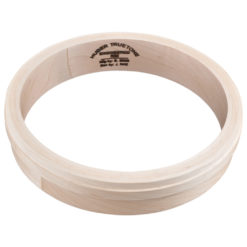
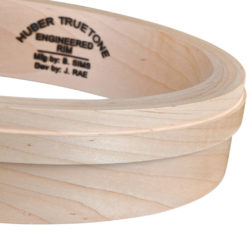
The Engineered Rim was developed using similar approaches and measurements as those used for the development of the HR-30 ring. The studies have taken almost two years to reach the point where we believe they are ready to go into finished banjos.
Initially, the vibration properties were measured for 28 isolated Gibson prewar rims. Of those, two were deemed by knowledgeable listeners to make the best sounding banjos when used with other Gibson prewar banjo parts.
The goal then was to design 3-ply rims that matched these two prewar rims. This required developing quantitative procedures for selecting wood at the lumber yard. When this was accomplished, detailed measurements of the wood’s vibrational properties were done to determine what changes would be necessary to make the wood match the properties of the prewar rim wood.
This required working out ways to treat the wood that modified its vibrational properties in repeatable and measureable ways. Many measurements were taken as well as repeats of the processes to determine levels and durations that resulted in the desired wood properties. It was equivalent to “tuning” the wood to the desired properties.
This was done on every ply of every potential rim and then the plys were assembled so as to best match the prewar rim properties. We also had good measurements to quantify the vibration transfers that occurred between the original prewar rims and their prewar rings when the ring was sitting on top of the rim on isolation mounts. The best pairs showed substantial ability for the vibrations to flow between ring and rim.
So, this criterion was also incorporated in the design requirements for the HR-30 rings and the Truetone rims. Not only did each part vibrate in ways we could control but they also matched to an extent that vibration transfer between the two was facilitated. To date, only about 15% of the starting plys match the stringent requirements we have set and thus end up in Truetone rims.